How Is Studying BTEC Different from Traditional University? A Realistic Year-to-Year Comparison
24 November, 2025 2025-11-29 2:28How Is Studying BTEC Different from Traditional University? A Realistic Year-to-Year Comparison

How Is Studying BTEC Different from Traditional University? A Realistic Year-to-Year Comparison
In recent years, the UK’s BTEC programme has become an increasingly attractive option for Vietnamese students who want a practical, career-oriented pathway focused on application and hands-on learning. However, many students and parents still ask the same question:
“How is BTEC different from traditional university? And what does an actual academic year look like?”
This article provides a detailed comparison between BTEC Level 4 and the conventional university model—looking at programme structure, learning methods, assessment formats, and student experience. Through this, you can clearly identify which environment best suits your goals and learning style.
1. Training Philosophy: Practical or Academic?
The biggest distinction between BTEC and traditional universities lies in their educational philosophy.
- BTEC is built for learning by doing, with a strong vocational and industry-focused orientation.
The programme emphasises applying knowledge to real situations through assignments, projects, case studies, and presentations. - Traditional universities aim to provide broad academic foundations, often with heavier theoretical content, especially in core subjects. Assessment largely relies on midterm and final exams that test memory, comprehension, and analytical ability.
Both approaches have value—but the right fit depends on the student’s personal goals.
2. What Does One Academic Year Look Like?
Placed side-by-side, the differences in how a year is structured become very clear.
- BTEC Level 4:
Students take individual modules one at a time.
Each module ends with 1–2 major assignments that determine the final grade.
The academic year is divided into project-based periods, allowing students to focus deeply on specific skills. - Traditional university:
Students study multiple subjects simultaneously within one semester.
The timetable is dense and changes weekly.
Each subject lasts 12–15 weeks and typically ends with a final exam.
This creates very different learning experiences:
Students in BTEC tend to feel more in control and focused, while traditional university students cover a broad range of content but may lack hands-on application.
3. Assessment: Assignments or Exams?
Nothing highlights the difference more clearly than assessment methods.
At BTEC:
- No final exams
- Evaluation is based on:
- Assignments
- Portfolios
- Case studies
- Presentations
- Group projects
- Students must research, analyse, and propose solutions—mirroring real business environments.
At traditional universities:
- 60–70% of the grade comes from final exams
- Tests are typically theory-based and memory-focused
- Some majors include practical components, but the level of application varies widely
Because of this, BTEC students often develop stronger soft skills such as time management, problem-solving, teamwork, and critical thinking.
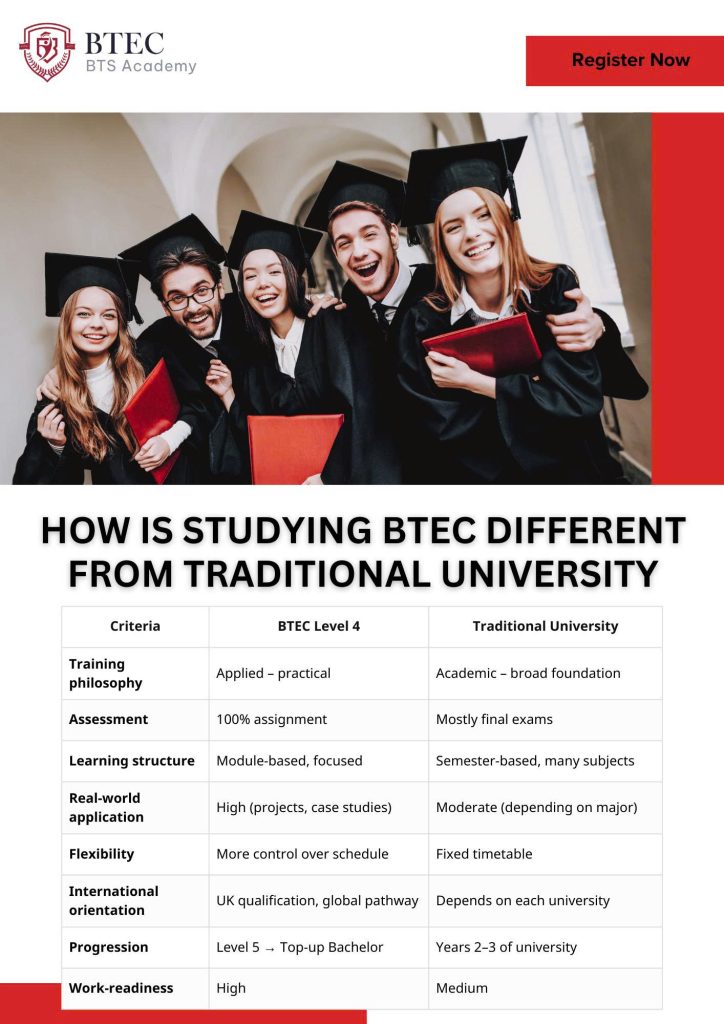
4. Comparison Table: BTEC vs. Traditional University
5. Why Do BTEC Students Often Become “Work-Ready” Faster?
BTEC students typically gain confidence early because:
- Assignments simulate real business challenges:
business planning, market analysis, financial management, marketing campaigns. - Students frequently present in front of lecturers and industry partners.
- The learning environment is highly interactive—no passive note-taking.
- Workload is spread evenly throughout the year, requiring consistent discipline.
For students who want to become employable quickly, this is a major advantage.
6. Is BTEC Easier or Harder Than Traditional University?
Many people assume BTEC is “easier” because there are no exams—but the reality is the opposite.
What makes BTEC challenging:
- A high level of independent study
- Continuous deadlines
- Must understand concepts deeply—no rote memorisation
- Assignments typically range from 2,500–4,000 words with academic referencing
Traditional university follows a familiar pattern for Vietnamese students: study → exam → break → exam again. The pressure varies depending on major and institution.
7. Who Is BTEC For?
BTEC Level 4 is well-suited for students who:
- Prefer practical learning over memorisation
- Want a fast-track route to an international Bachelor’s degree (3 years total)
- Intend to study abroad or transfer to a Top-up programme
- Have early interest in business, management, marketing, or finance
- Want to join the workforce sooner
If your goal is strong academic foundations for future research or postgraduate study, traditional university might be a better fit. But if you prioritise professional skills, real-world application, and an international qualification, BTEC is an excellent choice.
The Difference Lies in Your Goals and Experience
There is no “better” model—only the model that suits you best.
BTEC offers a modern, industry-aligned approach tailored to global workforce needs.
Traditional universities provide deep academic grounding and broad theoretical knowledge.
What matters is understanding what you want—and choosing the right path.
If you would like to learn more about the BTEC Level 4 programme at BTS Academy BTEC Centre, the Level 5 → Top-up pathway, or career opportunities for graduates, you can leave your information for 1:1 guidance.